
Dry Needling vs. Active Release Technique (ART): Which Is Right for You?

If you're a weekend warrior, a recreational athlete, or someone who just wants to get back to being active after an old injury has been holding you back, you've probably run into two treatment names that get thrown around a lot at chiropractic and sports medicine clinics in Nashville: dry needling and Active Release Technique (ART). Patients often ask which one they should get, as if it's an either/or decision. In my practice, it rarely is. Both are powerful tools, they work in different ways, and knowing when to reach for each (or both) is a big part of getting you back to training, running, lifting, or just moving without pain.
Here's how I actually think about these two techniques, what they feel like from the table, and how we decide which one, or which combination, makes sense for your injury.
What Is Dry Needling?
Dry needling uses a thin, solid filament needle inserted directly into muscle tissue, often targeting a trigger point or a specific area that isn't getting enough blood flow. Unlike a hypodermic needle, it isn't putting anything into your body or drawing anything out. It's a mechanical and neurological stimulus that helps reset an irritated muscle and drive fresh blood flow into tissue that's been chronically undernourished.
Dry needling tends to be my first choice in a few specific situations:
- Tendon problems that have been around for a while. A lot of "tendonitis" that's stuck around for months isn't actually inflamed anymore, it's tendonosis, a degenerative change in the tissue rather than an active inflammatory process. Needling is excellent at driving the blood flow and cellular response that degenerated tendon tissue needs to actually heal.
- When active movement is too painful to work with. If a patient can't tolerate much active range of motion but can tolerate lying still on the table, needling lets us treat the tissue without asking the body to do something it isn't ready for yet.
- Deep tissue that's hard to reach any other way. Structures like the hip external rotators or deep lumbar musculature sit underneath layers of other tissue. A needle can get to that depth in a way that hands or tools simply can't.
What Is Active Release Technique (ART)?
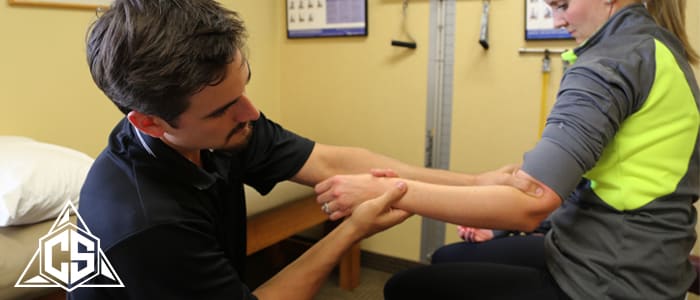
ART is a hands-on, manual technique where I combine precise tension with very specific patient movement to free up muscles, nerves, and other soft tissue that have become restricted or "stuck" to surrounding structures. It's not massage, and it's not generic soft-tissue work. True ART is highly specific to the exact tissue and the exact restriction we're trying to address.
ART tends to be the better tool when:
- There's a repetitive-use injury with a nerve that's gotten caught up in surrounding tissue and isn't gliding the way it should.
- A joint only feels symptomatic near the end ranges of motion. ART lets us work through that specific range and restore the movement that's missing.
- Active range of motion is possible and useful. Any time a patient can move through a position while I'm working, I prefer to use that. ART is built around combining motion and tension together, so it lets us restore function while we treat.
What It Actually Feels Like
I get it, needles sound scary to a lot of people, and I understand that reaction because I don't love needles myself. But dry needling has nothing in common with the hypodermic needles most people are picturing. The needles used for dry needling are extremely thin, solid filaments, and most patients barely feel them go in. We'll often add a small electrical stimulation to the needle to create a gentle muscle contraction, similar to what you'd feel with stim therapy, and most people find it more comfortable than they expected, sometimes even more comfortable than firm manual work or tool-based treatment.
One misconception worth clearing up: a lot of patients come in expecting, or even wanting, to feel a muscle "twitch" during needling. That twitch response doesn't actually correlate much with how effective the treatment is. Don't judge the session by whether you felt a twitch.
ART feels different. I'm upfront with patients that it isn't meant to feel relaxing. You should expect it to be uncomfortable. Somewhere around a 5 or 6 out of 10 on a pain scale is normal and expected. But we always work within a range you can tolerate, because if we push past that, the tissue responds by guarding and locking down, which works against what we're trying to accomplish. Good communication during the session lets us apply enough pressure to make real change without tipping into a range that backfires. It's a fine line, but when we find it, I hear the same phrase from patients constantly: "this hurts so good."
It's also worth knowing that not all "ART" is created equal. True ART is a highly specific, protocol-driven technique. It's a different level of specificity than a general pin-and-stretch massage technique, even though those can look similar from the outside. If you've had that kind of soft-tissue work before and didn't love it, it's not necessarily a preview of what true ART feels like.
When I Use Both Together
Some of the best results come from combining both techniques rather than picking just one — especially with old scar tissue. Nothing restores blood flow into scarred, poorly-perfused tissue quite like a needle. But scar tissue also isn't specific. It tends to bind up surrounding muscles, nerves, and other structures that need to move independently of it.
In those cases, I'll often use ART first to restore as much relative motion between those structures as possible, then finish with dry needling to improve blood flow directly into the scarred tissue itself that isn't getting good perfusion. Each technique is doing a job the other one isn't built for.
Having both tools available also matters for a simpler reason: sometimes a patient's tolerance for needles, pressure, or the range of motion required for one technique just won't allow for it that day. Having a high-quality plan B, rather than no alternative at all, means treatment doesn't stall out. And it isn't only about necessity. Sometimes it comes down to patient preference, and that's a perfectly valid reason to choose one over the other.
What's interesting is how often patients are surprised by the technique they didn't ask for. Many people come in with their mind made up that they want dry needling, or that they only want ART, and after a few sessions of layering both in, they find real, distinct value in each one. Neither is a "backup" to the other; they're just different tools solving different problems.
Who Benefits Most From These Treatments
This approach is built for weekend warriors, recreational athletes, and anyone who wants to get back to being active but has been sidelined, or held back, by a past or current injury. If pain, stiffness, or an old nagging injury has been the thing standing between you and training, running, lifting, or just moving the way you used to, this is exactly the kind of problem dry needling and ART are designed to solve.
The Bottom Line
Dry needling and ART aren't competing treatments. They're two distinct tools that address different problems in different ways. Chronic tendon issues, deep musculature, and situations where active movement isn't tolerable tend to respond well to needling. Nerve entrapments, end-range joint restrictions, and situations where we can use active motion during treatment tend to respond well to ART. And when old scar tissue is involved, combining both often gets better results than either alone.
If you've been dealing with an injury that's kept you from training or staying active, understanding these options is the first step toward figuring out the right path forward.